|
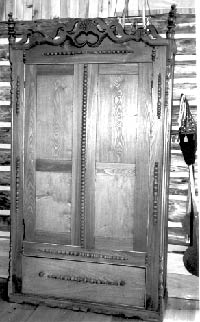
This beautiful cupboard (szafa) which is now on display at the Polish Kashub Heritage Museum in Wilno* had been in the possession of antique collectors and
restorers, Dennis and Lorna Peterson for the past twenty-five years. Although they were unsure of the exact origins of the cupboard which
they purchased from another collector, they were told that it came from the Andrecheck family. Polish Kashub Heritage Museum in Wilno* had been in the possession of antique collectors and
restorers, Dennis and Lorna Peterson for the past twenty-five years. Although they were unsure of the exact origins of the cupboard which
they purchased from another collector, they were told that it came from the Andrecheck family.
Dennis Peterson, who is a skilled woodworker, describes the cupboard as "built of brown ash (also known as black ash and swamp ash) which was commonly used by Polish and German cabinetmakers
because of its attractive grain and because it was pleasant to work with, unlike oak. Most ash pieces were not painted, but varnished to
show the beauty of the grain. Furniture made of pine was mostly painted , but not always. The secondary wood used in this cupboard
ie. top, back boards, drawer sides & shelves is basswood. The frames of the doors are made with 'through' tenons going right through the stiles and tightened with 2 wedges at the ends of
each tenon to expand the tenon so as to hold its position forever. The panels in the doors and sides are chamfered on the inside. Sometimes the chamfer is facing to the outside and
is referred to as a 'blown panel'."
|