THE KASHUB LANGUAGE
The Polish Kashub people in Wilno and area brought two languages from Poland in 1858: the language they speak at home and at work is the Kashub language;
but the language of their church is the Polish language. The mass is said in the Polish language, all the prayer books are written in the Polish language and the hymns and prayers are in Polish.
From the beginning, our ancestors thought they spoke a dialect of the Polish Language and some have even said that they speak a "low" form of the Polish
Language. In Poland, there has been a debate on the subject of this dialect. The Kashub culture has been fighting for centuries to lay claim that their language has a name and is not a dialect of another language
but a language that stands on its own, having 76 different dialects itself.
On January 6, 2005, the Polish Parliament passed the new Minorities and Regional Language Law, in which Kashub was finally acknowledged as a
language.
In Canada, the Kashub language is still alive after 149 years. This language is spoken by fourth, fifth and even a few sixth generation Canadian Kashubs,
but it is a language that is on the verge of being lost forever. The Heritage Society feels that we may have approximately 30 years before the language disappears. One of the mandates of the Society is to try to
preserve the Kashub language in Canada. To this end, we have purchased many Kashubian Language books from Kaszuby Poland.
One of these books written by Witold Bobrowski and Katarzena Kwiatkowsko is called " KASZEBSCZE ABECADLO" and is a book that is used in Poland to teach the written and spoken
Kashub language to elementary school children. (Kashub was not a written language until the early 1900's when it was finally documented by Dr.
Alexander Majkowski.) In Canada, the Kashub language is historically a spoken language and so while this book is an excellent introductory text book, until we have a person who
understands the written Kashub text, it will remain a book of interest only, instead of being the valuable teaching tool it should be.
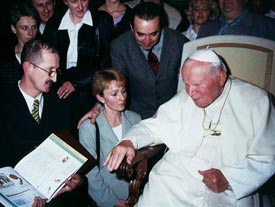
The Pope endorsed the Kashub Elementary book on his visit to the Kaszuby region in 2000. The Pope also addressed the Kashub people and said that they should hold onto their Kashubian
language and their unique Kashub Culture.
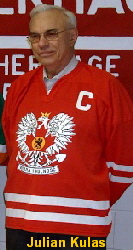
Fortunately we have as a member of the Wilno Heritage Society, Mr. Julian Kulas, a fourth generation Canadian
Kashub, who is working on a project that will change everything. Julian was a professional translator and is working on a small English/Kashub, Kashub/English dictionary. This will help us
teach the written language.
Presently, the only way our language is surviving is by parents and grandparent speaking it to their children. As this is
happening less and less often in our Canadian community, we are hoping to someday have Kashubian language classes in our schools once we get our books and teachers together.
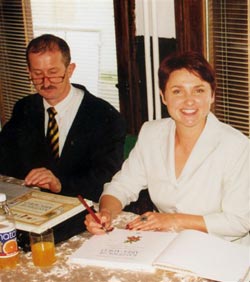
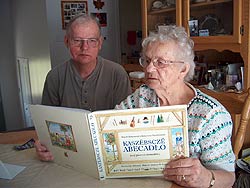
Many people have purchased the Kashub Elementary book, including Mary and Kenny Borutski (pictured above). Mary (age 90) is thrilled to find her native tongue in print.
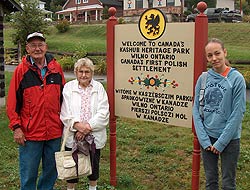
The Wilno Heritage Park has many visitors and one of the most photographed items in the park is the welcome sign which is written in both English and Kashub.
For an example of what the written Kashub Language looks like, check out what our Kashub friend, Wojtek Etmanski has to say to Canada's Kashubs on Heritage Night 2002:
A Kashub Speaks
Another facet of our Kashubian Language is the difference between the spelling of traditional Kashubian and Polish names in Poland, Canada and the United States. Documentation on
these differences and a list of the most common names can be found at the following link:
|